
FORMULA 1 | SÃO PAULO GRAND PRIX 2026
DAG MANAGEMENT EDITORIAL
Interlagos is more than a circuit: it is a test of feel, composure and responsibility. The 2026 São Paulo Grand Prix changed character repeatedly, from rain-soaked qualifying to a race that began wet, dried out and finished on intermediate tyres once again. For DAG Management, the weekend demonstrates why technical preparation must be matched by the ability to make decisions as conditions change lap by lap.
Lando Norris delivered a victory of considerable maturity. Pole position in 1:27.470 in heavy rain laid the foundation for a Sunday in which the McLaren driver absorbed the loss of the lead at the start, interpreted the transition to slick tyres and built a decisive advantage. This was not merely a demonstration of speed: it was an example of emotional control, tyre intelligence and collaboration with the pit wall.
Max Verstappen’s recovery from 21st on the grid to second deserves special recognition, as does Isack Hadjar’s podium. Mercedes, despite an imperfect race for Russell and Antonelli, secured the 2026 Constructors’ Championship. That achievement confirms that titles are built across an entire season, not solely through perfect weekends.
I am also particularly interested in Rafael Câmara’s home debut and the pressure experienced by Gabriel Bortoleto. In such demanding circumstances, every lap completed, every mistake analysed and every constructive reaction has developmental value. This is the principle behind the DAG analysis: assess the result, but above all understand the process that produced it.
FRIDAY – PRACTICE AND PREPARATION
Friday running allowed teams to work on high-speed balance, slow-corner traction and tyre efficiency. Interlagos is a short lap, yet the gaps accumulate in the opening sequence, the technical middle sector and the final acceleration to the line.
The central engineering question was how to prepare a setup capable of operating across different conditions. A highly responsive dry-weather car can become nervous in the wet; extra downforce may support confidence through the corners while compromising straight-line speed. Driver feedback and accurate weather anticipation therefore carry exceptional weight.
SATURDAY – FP3 AND RAIN-AFFECTED QUALIFYING
Verstappen topped FP3 in 1:11.622, just 0.025s ahead of Antonelli. Norris was third, 0.131s behind, followed by Russell and Leclerc. The four leading teams were covered by only 0.274s, demonstrating how close the dry-weather performance was.
Rain then transformed Qualifying. After delays and red flags, Norris secured pole in 1:27.470, beating Russell by 0.204s and Antonelli by 0.625s. Leclerc qualified fourth, Lawson fifth, Hülkenberg sixth and Hadjar seventh. Bearman, Alonso and Albon also reached Q3, each delivering an impressive lap in the conditions.
The decisive skill was producing a clean lap in the best available weather window before conditions deteriorated. Grid penalties for Russell and Leclerc, together with technical penalties affecting Hamilton and Verstappen, substantially changed the starting order. The DAG lesson from Norris is straightforward: when weather is unstable, postponing the decisive lap can mean losing the opportunity entirely.
SUNDAY – CHRONOLOGICAL RACE ANALYSIS
The damp but drying track demanded continuous assessment of grip. Antonelli took the lead from second on the grid; Lawson moved into second, while Norris avoided forcing the issue in the opening corners. Further back, Hamilton rapidly gained positions from P20 and Verstappen from P21, demonstrating how elite drivers find alternative lines without losing composure.
Intermediate tyres began to overheat as the track dried. Hamilton was among the first to switch to slicks on Lap 14; Norris, Russell and Hadjar stopped on Lap 16, Antonelli and Verstappen on Lap 17. Russell lost time spinning at pit exit. Antonelli retained the lead, but Norris, on warmer tyres, rapidly closed the gap.
Antonelli spun at Turn 1 on Lap 20, handing Norris the lead. Further moments at the same corner cost him positions to Hadjar and Verstappen. This sequence is an important case study: during a wet-to-dry transition, the tyre operating window can change faster than the timing screen suggests.
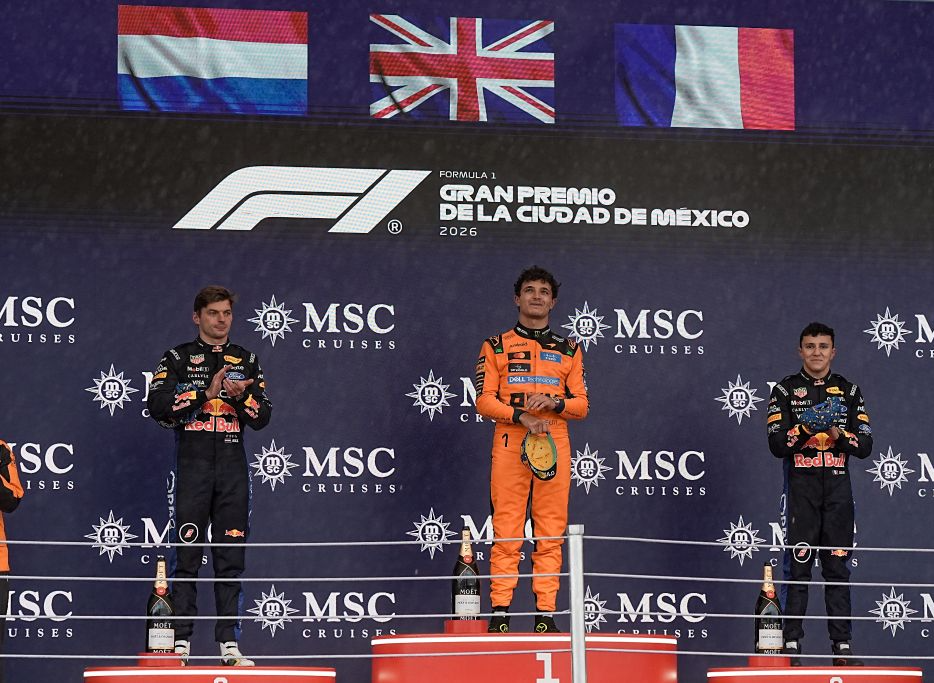
Norris built his margin with consistent pace and measured decisions. Verstappen continued his recovery to second, while Hadjar managed his race with considerable maturity and secured the final podium position. Second-round pit stops temporarily reshuffled the order, but McLaren retained strategic control.
When rain returned late in the race, switching back to intermediates became essential. Russell and Alonso were among the first to stop on Lap 61; the rest followed. Hamilton brushed the wall after a spin but continued. Norris completed 71 laps in 1:35:23.504, finishing 14.602s ahead of Verstappen and 24.485s ahead of Hadjar.
The official final top ten, including penalties, was Norris, Verstappen, Hadjar, Russell, Antonelli, Piastri, Lawson, Leclerc, Hamilton and Hülkenberg. Antonelli and Bearman received five-second unsafe-release penalties, while Leclerc received five seconds for causing a collision. Any professional analysis must distinguish the on-track order from the final classified result.
TECHNICAL AND STRATEGIC ANALYSIS
INTERMEDIATE-TO-SLICK CROSSOVER. This was the first decisive phase. Stopping too early risked losing grip on damp sections; waiting too long overheated the intermediates. Tyre warm-up on pit exit immediately affected the gaps.
EVOLVING STRATEGY. Teams had to balance track-position protection against anticipating tyre changes. Returning rain required another adaptation, making the Grand Prix an exercise in forecasting and precise radio communication.
RISK MANAGEMENT. Spins involving Antonelli and Russell, together with off-track moments elsewhere, demonstrate that braking precision and patience on throttle application matter as much as underlying car performance.
PENALTIES AND OPERATIONS. Unsafe-release and contact penalties show that pit procedures, safety and wheel-to-wheel discipline contribute directly to the final outcome. Classification must always be interpreted after stewards’ decisions.
DAG MANAGEMENT REPORT CARDS
DAG editorial ratings, 1–10 scale. Scores account for pace, execution, conditions, penalties and technical context; no rating for DNS.
MCLAREN — RATING: 9.5
LANDO NORRIS | P1 | RATING: 10
Pole in heavy rain, controlled the wet–dry–wet race and won by 14.602 seconds.
OSCAR PIASTRI | P6 | RATING: 7
Recovered from a Q2 exit to sixth; useful points in a complex tyre and visibility window.
RED BULL RACING — RATING: 9.5
MAX VERSTAPPEN | P2 | RATING: 10
A remarkable recovery from P21 to P2, with decisive overtakes and excellent adaptation to grip changes.
ISACK HADJAR | P3 | RATING: 9.5
Seventh in qualifying, third in the race; measured tyre decisions and a valuable podium under pressure.
MERCEDES — RATING: 8.5
GEORGE RUSSELL | P4 | RATING: 7.5
Qualified second but incurred a grid penalty and spun at pit exit; recovered to fourth, contributing to the constructors’ title.
KIMI ANTONELLI | P5 | RATING: 7.5
The new world champion led early, then spun as conditions evolved; fifth after an unsafe-release penalty, with valuable points for Mercedes.
RACING BULLS — RATING: 8.5
LIAM LAWSON | P7 | RATING: 9
Qualified fifth in the wet, ran second early and converted strong pace into seventh place.
ARVID LINDBLAD | P11 | RATING: 7.5
Strong practice pace and a composed race just outside the points.
FERRARI — RATING: 6.5
CHARLES LECLERC | P8 | RATING: 7
Qualified fourth but carried a grid penalty; fought back before a five-second collision penalty left him eighth.
LEWIS HAMILTON | P9 | RATING: 7.5
From P20 to the points on his 400th Grand Prix start, despite tyre struggles and a late spin.
AUDI — RATING: 7.5
NICO HÜLKENBERG | P10 | RATING: 8.5
Outstanding sixth in wet qualifying and one championship point despite a difficult, changing race.
GABRIEL BORTOLETO | P16 | RATING: 6.5
A home race marked by a Q1 crash; completing the Grand Prix offered important learning.
ASTON MARTIN — RATING: 6.5
FERNANDO ALONSO | P12 | RATING: 7.5
Ninth in qualifying and a disciplined finish, narrowly outside the points.
LANCE STROLL | DNF | RATING: 5.5
Retired after 30 laps; reliability and limited running prevent a complete assessment.
ALPINE — RATING: 6
FRANCO COLAPINTO | P13 | RATING: 7
Completed a demanding race and finished ahead of his team-mate, a useful step in mixed conditions.
PIERRE GASLY | P14 | RATING: 6.5
Finished the race but could not turn changing conditions into points.
WILLIAMS — RATING: 5.5
ALEXANDER ALBON | P15 | RATING: 6
Reached Q3 in the rain but lost ground during the Grand Prix; execution and tyre timing warrant review.
CARLOS SAINZ | P19 | RATING: 5.5
A difficult afternoon with limited pace and two laps lost; focus on the next development opportunity.
HAAS — RATING: 5.5
OLIVER BEARMAN | P17 | RATING: 6
Q3 appearance in challenging conditions; five-second unsafe-release penalty compounded a difficult race.
RAFAEL CÂMARA | P20 | RATING: 7
Formula 1 debut on home soil in exceptionally demanding conditions; finishing was a meaningful learning milestone.
CADILLAC — RATING: 5
SERGIO PÉREZ | P18 | RATING: 6
Completed the race in difficult conditions; a chance to gather data and improve operational consistency.
VALTTERI BOTTAS | DNS | NOT RATED
Did not start owing to a pre-race technical problem; no sporting rating is appropriate.
CHAMPIONSHIP PERSPECTIVE
Kimi Antonelli had already secured the Drivers’ World Championship in Mexico. In São Paulo, Mercedes added the 2026 Constructors’ Championship through the points scored by Russell and Antonelli, completing a remarkable season. The achievement is especially meaningful because it came in a complicated race marked by mistakes and recovery drives.
Norris claimed his third victory of the season and underlined his late-season competitiveness. Verstappen’s charge from the back strengthened his campaign for the leading positions behind the champion, while Red Bull secured a double podium. DAG’s interpretation is clear: championships reward consistency, but also the ability to turn difficult Sundays into valuable points.
DAG MANAGEMENT HIGHLIGHTS
DRIVER OF THE WEEKEND – LANDO NORRIS: wet-weather pole, strategic control and victory.
RECOVERY OF THE WEEKEND – MAX VERSTAPPEN: P21 to P2.
BREAKTHROUGH PERFORMANCE – ISACK HADJAR: a podium built on composure.
TEAM ACHIEVEMENT – MERCEDES: 2026 Constructors’ Championship.
MIDFIELD SPOTLIGHT – LIAM LAWSON: qualifying P5 and race P7.
ROOKIE DEVELOPMENT – RAFAEL CÂMARA: completed his F1 debut in extremely challenging conditions.
DAG MANAGEMENT CONCLUSIONS
Interlagos reminded us that motorsport does not reward only the fastest driver in ideal conditions. It rewards those who understand change, accept calculated risks, communicate clearly and remain composed when the original plan no longer works.
Norris displayed the most complete combination of those qualities. Verstappen demonstrated exceptional recovery ability. Hadjar converted a competitive weekend into a meaningful podium. Mercedes showed that championships are earned by an organisation capable of delivering over a full season, even when an individual Sunday is imperfect.
For DAG Management, I consider the message to young drivers particularly valuable: every session must become learning, every mistake a data point, and every result a foundation for progress. Genuine development comes from combining talent, method and responsibility.