
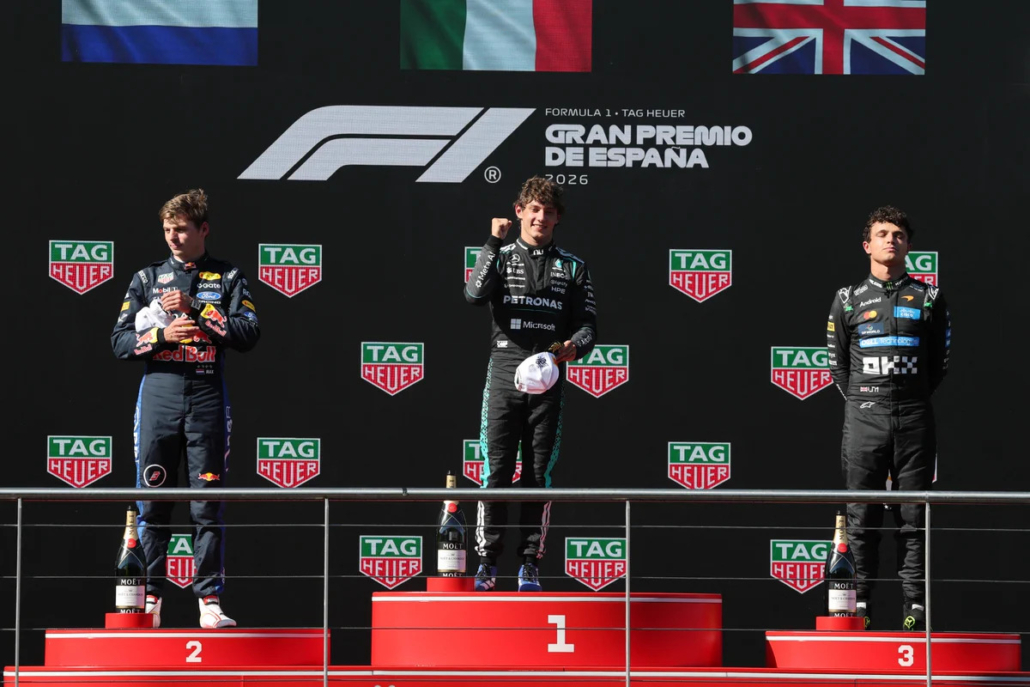
FORMULA 1 – 2026 SPANISH GRAND PRIX, MADRID
Madrid entered Formula 1 history with a weekend that was difficult to read, strategically fascinating and, in the decisive moments, brutally unforgiving. The first Grand Prix at the new 5.414-kilometre Madring was always going to be a voyage into the unknown: 22 corners, a mixture of street and permanent-circuit characteristics, high-speed sections, walls close to the racing line, the spectacular banked La Monumental and very little historical data on tyres, race evolution or overtaking.
For DAG Management, this inaugural Madrid weekend underlined one of the most important realities of modern Formula 1: the fastest car over the first stint does not automatically win the race. Lando Norris produced an extraordinary qualifying lap and appeared to have the Grand Prix under control for much of the opening phase. Yet a short Virtual Safety Car, a missed strategic window and a seven-second pit stop changed the entire competitive order. Kimi Antonelli and Mercedes reacted immediately and converted opportunity into victory, while Max Verstappen again demonstrated his capacity to stay close enough to benefit when a race changes direction.
Antonelli’s eighth victory of the season, one week after his remarkable Monza comeback, further strengthened his championship position. But this was a very different win. In Italy he had to create the result through a recovery from P19. In Madrid he had to remain patient behind a faster Norris, survive early mistakes and tyre-management difficulties, react to a strategic opening and then control the final phase despite concerns over the steering. The result was another demonstration that championship campaigns are built through very different kinds of victories.
FRIDAY – LEARNING A CIRCUIT FROM ZERO
The first challenge of Madrid was information. Every driver and every engineering group began Friday without meaningful Formula 1 race data from the circuit.
Mercedes adapted quickest. George Russell topped FP1 with Kimi Antonelli second, immediately suggesting that the W17 had found a strong operating window on the new surface. Antonelli then moved to the top in FP2. Across the opening day, Mercedes combined one-lap performance with a particularly convincing ability to generate confidence through Madring’s high-speed sections.
Ferrari was also competitive. Charles Leclerc and Lewis Hamilton remained close to Mercedes during the opening running, giving the Scuderia reason to believe that Madrid could offer a stronger opportunity than the final Monza result had suggested.
McLaren’s Friday was less spectacular on the timing screens than what would follow on Saturday. The team was learning how to balance tyre preparation with the grip evolution of a brand-new track, but Norris continued to build confidence and ultimately found the decisive performance when it mattered most.
The circuit itself punished mistakes immediately. Arvid Lindblad crashed in FP2, while Saturday morning brought further major incidents for Hamilton and Oliver Bearman. The interruptions reduced long-run information and made Sunday’s tyre picture even more uncertain. Graining and thermal degradation became central themes, and the lack of clean practice running meant teams entered the race with more questions than usual.
SATURDAY – QUALIFYING
Qualifying produced one of the finest single laps of the season.
Kimi Antonelli had looked capable of pole after leading FP2 and FP3, and Lewis Hamilton briefly held provisional P1 during Q3. But Lando Norris delivered when the circuit was at its fastest and the pressure at its highest.
Norris’ 1:31.824 secured pole by only 0.011 seconds over Antonelli. Max Verstappen was third, only 0.140 from pole, followed by Hamilton, Leclerc and Russell. Oscar Piastri qualified seventh, Liam Lawson eighth, Franco Colapinto ninth and Arvid Lindblad tenth.
The top six were separated by less than two tenths, illustrating how sensitive the new circuit was to confidence, tyre preparation and execution.
For Norris, the lap was exceptional because it arrived at the very end of Q3, when there was no second opportunity. He committed to the walls, the braking zones and the high-speed direction changes and produced a lap that placed McLaren in control of the start.
Antonelli could reasonably be disappointed to miss pole by eleven thousandths, particularly after setting the pace through much of the weekend, but P2 kept him perfectly positioned for Sunday.
Verstappen’s third place again demonstrated Red Bull’s ability to remain in the fight even when Mercedes and McLaren appeared to have a small underlying advantage.
Hamilton’s fourth place was an excellent recovery after his FP3 accident. Leclerc was only six thousandths behind him in fifth. Russell, by contrast, suffered from overheating tyres and could manage only sixth, a significant setback in his championship battle.
Piastri’s seventh position represented another difficult qualifying comparison with Norris. Lawson continued his encouraging adaptation to the Red Bull with eighth. Colapinto gave Alpine a valuable Q3 appearance, while Lindblad recovered impressively from his Friday crash to complete the top ten.
Behind them, Audi narrowly missed Q3 with Hülkenberg 11th and Bortoleto 12th. Ocon was 13th ahead of Gasly, Tsunoda and Albon.
For the Spanish crowd, qualifying was painful. Carlos Sainz and Fernando Alonso were both eliminated in Q1. Sainz was then penalised three grid positions for impeding Valtteri Bottas, dropping him to P20. Bearman could not participate after the heavy FP3 crash, while Stroll was unable to run because of a suspected water-pressure problem. Both would face severely compromised Sundays.
RACE – A GRAND PRIX DECIDED BY TIMING
The opening lap immediately showed the intensity created by an unfamiliar circuit and a field on different tyre strategies.
Norris and Antonelli started on mediums. Verstappen and Hamilton chose softs to attack immediately. Leclerc, Russell, Piastri and Lawson began on hards, looking for a longer first stint.
Antonelli attacked Norris into the opening sequence but was forced to cut the first chicane. He tried again and made another off-track excursion, allowing Verstappen to move into second. The opening phase was aggressive and imperfect from the championship leader, who was clearly determined not to allow Norris to escape.
Verstappen was subsequently instructed to return a position after the first-corner sequence, reshuffling the order again. Hamilton briefly benefited, but his race rapidly unravelled as brake problems became increasingly severe. He fell behind Verstappen and Leclerc before Ferrari retired the car after only seven laps.
At the front, Norris began to build the race he wanted. Once the opening chaos settled, the McLaren created a gap of approximately 4.5 seconds over Antonelli. The Mercedes driver also suffered another off-track moment, while his medium tyres appeared less comfortable on the high-grip surface than Norris’ set.
At this stage, Norris looked like the clear reference. His pace, tyre management and control from the front were excellent.
Behind the leaders, the first lap had badly compromised Piastri. Contact with Russell and further incidents left the McLaren with front-wing damage, dropping him into a midfield fight involving Colapinto, Lawson, Bortoleto and Lindblad.
Russell, starting on the hard tyre, began considering an alternative strategy to attack Leclerc. The Ferrari driver was running fourth and the battle behind the top three became increasingly strategic rather than purely pace-based.
The two Spanish drivers also collided in a deeply disappointing moment for the home crowd. Alonso felt Sainz had squeezed him into the wall at Turn 5, and the stewards later gave Sainz a five-second penalty.
Then came the decisive moment of the Grand Prix.
Lance Stroll stopped at Turn 20 with brake problems and triggered a Virtual Safety Car. Mercedes and Red Bull reacted immediately, calling Antonelli, Russell and Verstappen into the pits while the field was running at reduced speed.
McLaren did not get Norris into the pit lane before the VSC ended.
That single timing difference transformed the race. Norris had dominated the opening stint, but the strategic advantage disappeared in seconds. When he finally stopped under green-flag conditions, the damage was compounded by an agonising seven-second pit stop.
Norris rejoined behind Leclerc, Antonelli, Verstappen and Russell.
From DAG Management’s perspective, this was the key operational contrast of the weekend. Mercedes and Red Bull were ready to react instantly. McLaren’s window was extremely short, but at this level the difference between winning and losing can be exactly that short.
Leclerc, who had not stopped, now led the Grand Prix. Ferrari committed to a high-risk strategy, keeping him out in the hope of a Safety Car or red flag that could rescue track position and potentially create a podium or victory opportunity.
Behind him, Antonelli was effectively the net leader, although he reported that the steering felt unusual. Mercedes could see no obvious issue in the data and also warned him that further track-limit violations could produce a penalty.
Norris began his recovery. Russell made a second stop, simplifying the McLaren driver’s route forward, but Verstappen proved much harder to dislodge. Norris spent multiple laps close to the Red Bull without finding a clean way through.
Ferrari finally brought Leclerc in at the end of Lap 48. That released Antonelli, Verstappen and Norris to decide the first Madrid Grand Prix.
Antonelli responded at exactly the right moment. Rather than allowing Verstappen and Norris to close, he increased the pace and created enough breathing space to control the finish.
Norris had one final opportunity when Verstappen cut Turn 5. He drew alongside but could not complete the pass.
Antonelli won by 4.351 seconds from Verstappen, with Norris only 0.738 seconds further back in third. Leclerc finished fourth, 29.116 seconds from the winner, with Russell fifth.
Lawson delivered an excellent sixth for Red Bull. Colapinto finished seventh for Alpine, Piastri recovered to eighth despite his damaged front wing, Lindblad took ninth and Hülkenberg secured the final point for Audi.
Ocon finished 11th, followed by Gasly, Bortoleto, Tsunoda, Albon, Bearman, Alonso and Bottas. Hamilton, Stroll, Sainz and Perez retired.
DAG MANAGEMENT REPORT CARDS
MERCEDES – RATING: 9.5
Mercedes leaves Madrid with the victory and a further extension of Antonelli’s championship advantage, but the team’s weekend was more complex than the result suggests.
The car was immediately competitive on the new circuit. Russell led FP1, Antonelli topped FP2 and FP3, and the team clearly understood the Madring quickly.
On Sunday, the strategic reaction to Stroll’s VSC was excellent. Mercedes recognised the window instantly and brought both cars in. That call was decisive for Antonelli’s victory.
The slight reduction from a perfect rating comes from Russell’s qualifying and final result. His tyre overheating in Q3 left him sixth, and fifth place in the race was below the potential Mercedes had shown all weekend.
KIMI ANTONELLI – RATING: 9.5
A second consecutive victory, but one constructed in a completely different way from Monza.
Antonelli was one of the fastest drivers from the first practice session and looked like the favourite for pole until Norris produced an exceptional final lap. Missing pole by 0.011 seconds was no failure; it showed how high the level at the front had become.
The start of the race was the least convincing phase of his weekend. Two early off-track moments while attacking Norris cost him momentum and temporarily allowed Verstappen ahead. Later he also had another excursion, and Mercedes had to warn him about track limits.
Those details matter in an analytical assessment. The race was not flawless.
But the response was excellent. Antonelli stayed close enough to Norris to remain strategically relevant, reacted perfectly to the VSC through the team, managed the unusual steering sensation and then delivered strong pace on the hard tyre when the victory was in his hands.
His post-race acknowledgement that Norris probably deserved the win also reflected an accurate reading of the race. Antonelli benefited from circumstances, but benefiting from circumstances is part of elite motorsport. He was in the correct position to take the opportunity and then made no mistake when he had to close the race.
Eight victories and an 81-point championship lead underline the larger picture: Antonelli is not simply winning when everything is perfect. He is collecting maximum results across very different race scenarios.
GEORGE RUSSELL – RATING: 7.5
Russell’s weekend began extremely strongly with P1 in FP1, but it became increasingly complicated.
Overheating tyres compromised his qualifying and P6 was a major disappointment given Mercedes’ pace. He also brushed the wall during Q1, another indication that he never found the same clean rhythm as Antonelli.
In the race, the hard-tyre start offered strategic flexibility. First-lap contact with Piastri added complexity, but Russell remained in the fight and Mercedes used the VSC well.
The second stop ultimately left him fifth. It was a solid recovery from a difficult Saturday, but in championship terms the weekend hurt: while Antonelli won, Russell scored only ten points.
MCLAREN – RATING: 8
This is one of the most difficult teams to rate because McLaren simultaneously produced the fastest race package and lost a race it appeared to control.
Norris’ pole and first-stint pace were outstanding. The car looked excellent in his hands and tyre management was strong.
But Formula 1 is an operational sport. The VSC timing was cruel, yet the subsequent seven-second stop compounded the loss. McLaren went from leading comfortably to having Norris rejoin fifth.
Piastri’s race was compromised on Lap 1 and he never had the opportunity to demonstrate the same pace.
The speed deserves a very high mark. The conversion of that speed into only third and eighth does not.
LANDO NORRIS – RATING: 9.5
Probably the strongest pure performance of the weekend despite not winning.
His qualifying lap was exceptional: pole by 0.011 seconds on a new circuit, delivered at the final possible moment.
In the race, he defended the lead under enormous pressure and then built a clear advantage. His first stint was the benchmark of the field. He appeared to have the race under control before the VSC.
The strategic timing was not his error, nor was the seven-second pit stop. Once dropped behind Verstappen, he attacked but discovered one of Madring’s defining problems: following closely was possible, passing was much harder.
He came close on the final laps but could not convert the opportunity.
Third place therefore understates his weekend. From a driver-performance perspective, Norris did almost everything required to win.
OSCAR PIASTRI – RATING: 6.5
A difficult weekend relative to his team mate.
P7 in qualifying was already a significant deficit to Norris. The opening lap then made the race substantially worse: contact involving Russell and other cars damaged the front wing and dropped Piastri into the midfield.
From there, eighth was a respectable recovery, especially with a compromised car.
However, McLaren’s underlying pace was capable of much more. The comparison with Norris remains the key issue: on a weekend when one McLaren fought for victory, the other spent most of the race recovering from the midfield.
RED BULL – RATING: 9
A very strong weekend.
Verstappen qualified third and finished second, while Lawson delivered an excellent sixth. Strategically, Red Bull reacted immediately to the VSC and kept Verstappen in the fight for victory.
The car did not have Norris’ first-stint pace or Antonelli’s final margin, but Red Bull maximised the opportunity.
MAX VERSTAPPEN – RATING: 9.5
Another performance built around positioning, aggression and race intelligence.
The soft-tyre start showed intent. Verstappen took advantage of Antonelli’s early mistake to move forward and remained a central part of the race despite the complicated position-return sequence.
The VSC stop was perfectly timed. In the final phase, Verstappen had Norris directly behind him for lap after lap and defended extremely well on a circuit where track position was powerful.
His Turn 5 cut gave Norris one late opportunity, but he recovered and retained second.
He did not have the fastest car. He still finished between the two drivers who arguably had the strongest packages. That is classic Verstappen maximisation.
LIAM LAWSON – RATING: 9
Lawson’s best weekend since stepping into the Red Bull seat.
He showed genuine speed in qualifying, at one stage topping Q1, and reached Q3 in eighth. That alone was encouraging on an unfamiliar circuit.
The race was even stronger. Starting on the hard tyre, he managed the opening phase well and became part of an intense midfield battle. He ultimately finished sixth, ahead of Colapinto and Piastri.
For a substitute driver still adapting to the car, this was an excellent result and a meaningful contribution to Red Bull’s weekend.
FERRARI – RATING: 6.5
Ferrari’s Madrid weekend contained speed, recovery and disappointment in almost equal measure.
Both cars were competitive through practice and qualified fourth and fifth. Hamilton’s recovery from his FP3 crash to P4 was particularly impressive.
Sunday, however, was compromised immediately by Hamilton’s brake failure. Leclerc then became the sole Ferrari hope and the team chose a very aggressive strategy, leaving him out long in the hope of a Safety Car or red flag.
The gamble did not pay off, but Leclerc still recovered fourth.
The pace was respectable. Reliability and strategic dependence on an external event prevented a stronger result.
CHARLES LECLERC – RATING: 8
A solid and intelligent race.
Leclerc qualified fifth, only 0.006 behind Hamilton. In the race he survived the opening chaos, moved ahead as Hamilton’s problems developed and positioned himself behind the leading group.
Ferrari’s decision to extend his stint was a gamble rather than a reflection of Leclerc’s pace. For many laps he led the race, but in reality he was waiting for a Safety Car or red flag that never came.
Once he finally stopped on Lap 48, fourth was the realistic outcome.
It was not a spectacular podium performance, but it was a strong recovery and maximum-value result after Ferrari lost the other car early.
LEWIS HAMILTON – RATING: 7
Hamilton’s weekend deserves to be separated into Saturday and Sunday.
After crashing heavily in FP3, he responded superbly in qualifying. He even held provisional pole in Q3 before Norris and Antonelli improved, eventually securing fourth.
That mental recovery was impressive.
Sunday ended through no meaningful fault of his own. He started aggressively on soft tyres and briefly became involved in the leading fight, but brake problems deteriorated rapidly. Ferrari retired him after seven laps.
The final result is a DNF, but the driver performance before the technical failure was stronger than that result suggests.
ALPINE – RATING: 8
A positive weekend led by Colapinto.
After Gasly’s spectacular Monza pole, Madrid presented a different challenge. Colapinto reached Q3 and then converted that starting position into seventh place.
Gasly had a much quieter weekend and finished outside the points, but Alpine still left Madrid with a useful result and further evidence that the car can compete in the upper midfield under the right conditions.
FRANCO COLAPINTO – RATING: 9
One of the midfield stars of the weekend.
Colapinto recovered from a difficult moment in qualifying around La Monumental, reached Q3 and started ninth.
In the race, he immediately placed himself in the points fight. He battled Lawson and later became part of the intense group with Bortoleto, Piastri and Lindblad.
Seventh place was an excellent conversion of opportunity and made him Alpine’s sole points scorer.
The performance combined speed with resilience and was one of his strongest weekends of the season.
PIERRE GASLY – RATING: 6.5
A significant contrast with Monza.
Gasly qualified 14th, behind Ocon and far behind team mate Colapinto. Starting on the hard tyre gave him strategic options, but the race never developed in his favour.
He finished 12th, just outside the points battle.
After the emotional high of pole one week earlier, Madrid was a reminder of how rapidly Formula 1 can change from circuit to circuit.
RACING BULLS – RATING: 7.5
Another useful points-scoring weekend, primarily through Lindblad.
The young driver recovered from a significant FP2 crash to reach Q3 and score points. Tsunoda’s weekend was more difficult, but both cars finished.
ARVID LINDBLAD – RATING: 8.5
A very mature recovery.
Crashing in FP2 on a new circuit could easily have damaged confidence for the rest of the weekend. Instead, Lindblad rebuilt his rhythm, reached Q3 and started tenth.
He remained in the midfield battle throughout Sunday and finished ninth.
The result is valuable, but the response to Friday’s accident is equally important from a driver-development perspective. The ability to reset after a mistake is a major component of progression at this level.
YUKI TSUNODA – RATING: 6
Tsunoda qualified 15th and finished 14th.
The race lacked the upward movement seen from Lindblad, and he never became a serious factor in the points battle.
It was a clean but relatively anonymous weekend.
AUDI – RATING: 7.5
Audi was competitive throughout the weekend and deservedly scored the final point.
Both cars narrowly missed Q3, with Hülkenberg 11th and Bortoleto 12th. In the race, Hülkenberg converted that position into tenth while Bortoleto became involved in a very strong midfield fight before finishing 13th.
NICO HÜLKENBERG – RATING: 8
A strong and efficient weekend.
Hülkenberg narrowly missed Q3, started close to the points and used the soft tyre aggressively at the beginning.
He stayed in contention and ultimately secured P10.
On a weekend where the margins in the midfield were extremely small, he extracted the point available.
GABRIEL BORTOLETO – RATING: 7
Bortoleto again showed encouraging qualifying pace and started 12th.
He became part of one of the most entertaining midfield battles of the race, fighting Colapinto, Piastri and Lindblad.
Ultimately he fell to 13th and missed the points, but the performance was more competitive than the final classification suggests.
HAAS – RATING: 5.5
Haas’ weekend was shaped by Bearman’s enormous FP3 accident.
The team could not repair the car in time for qualifying and had to build around a new chassis and power-unit elements, forcing Bearman to start from the pit lane.
Ocon carried the competitive responsibility and came close to points with P11.
ESTEBAN OCON – RATING: 7
Ocon qualified 13th and finished 11th.
It was a clean, effective weekend in a Haas that did not appear to have the pace of the leading midfield cars.
Missing the final point by one position is frustrating, but Ocon extracted a respectable result.
OLIVER BEARMAN – RATING: 5.5
The FP3 crash defined his weekend.
The damage was severe enough to rule him out of qualifying and require a new chassis. Starting from the pit lane on a circuit where overtaking proved difficult left very little realistic opportunity.
He finished 16th.
The positive is simply that he completed the race and provided mileage after the team’s extensive repair work. The lesson is the cost of a major practice error on a street-style circuit.
WILLIAMS – RATING: 4.5
A deeply disappointing home weekend for Carlos Sainz and a difficult event for the team overall.
Both cars were eliminated before Q3, Sainz received a grid penalty, and Sunday produced no points.
Albon at least reached the finish. Sainz did not.
CARLOS SAINZ – RATING: 4.5
A painful first Madrid Grand Prix in front of his home crowd.
Sainz qualified only 17th and was then dropped to P20 for impeding Bottas. The race began from a compromised position and became worse after contact with Alonso at Turn 5, for which Sainz received a five-second penalty.
He later retired with a separate car issue.
Emotionally, this was one of the most difficult weekends of the season for him. The home support was enormous, but there was no sporting reward.
ALEX ALBON – RATING: 6
Albon qualified 16th, narrowly ahead of Sainz, and started from the midfield-rear group.
He kept the car running and finished 15th as Williams’ only classified driver.
There was little opportunity to challenge for points, but his weekend was cleaner than the other side of the garage.
ASTON MARTIN – RATING: 4
A very difficult weekend with reliability problems dominating the story.
Stroll could not take part in qualifying because of a suspected water-pressure issue and later suffered the brake failure that triggered the decisive VSC.
Alonso was eliminated in Q1 and finished only 17th in his home race.
FERNANDO ALONSO – RATING: 5.5
The home crowd had hoped for far more.
Alonso qualified 18th and was involved in the Turn 5 incident with Sainz, for which the Williams driver was penalised.
He completed the race in 17th, but Aston Martin never had the performance to place him in the points fight.
For a driver of Alonso’s experience, the most frustrating element was probably the lack of tools available to change the outcome.
LANCE STROLL – RATING: 4.5
A weekend dominated by technical problems.
Stroll could not set a qualifying lap because of the water-pressure issue, then received additional grid consequences after power-unit component changes.
In the race, brake problems forced him to stop at Turn 20. That retirement triggered the VSC that ultimately changed the fight for victory.
For Aston Martin, his weekend was another reminder that reliability remains as important as performance.
CADILLAC – RATING: 4.5
Madrid was another development weekend without points.
Both cars were eliminated in Q1 and the race offered little opportunity to move forward. Bottas reached the finish in 18th; Perez retired with a suspected water-system problem.
SERGIO PEREZ – RATING: 4.5
Perez qualified 19th before grid adjustments and started on the medium tyre hoping to create strategic flexibility.
The race never developed into a points opportunity and ended with a suspected water-system issue.
Another frustrating weekend in a season still focused heavily on building the Cadillac project.
VALTTERI BOTTAS – RATING: 5
Bottas was the driver impeded by Sainz in qualifying, an incident that contributed to Sainz’s grid penalty.
He started ahead of the Spaniard after the adjustment but still lacked the pace to challenge the midfield.
P18 at the finish was the maximum available from a difficult weekend.
CHAMPIONSHIP PERSPECTIVE
Madrid strengthens Antonelli’s position substantially.
He now leaves the inaugural Madring Grand Prix with 292 points and an 81-point advantage over Russell on 211. The significance is not simply numerical.
One week ago at Monza, Antonelli won from P19 through overtaking and recovery. In Madrid, he won from the front group through strategic reaction and race management, despite Norris appearing faster for much of the opening stint.
That variety is important. Championship leaders need more than dominant wins. They need to score heavily when a rival has the better race, to recognise opportunities immediately and to survive imperfect phases without allowing them to become disastrous.
Russell remains second in the championship, but the momentum has moved sharply toward Antonelli. Norris continues to demonstrate that McLaren can challenge for victories and arguably produced the best driver performance in Madrid. Verstappen remains a constant threat whenever Red Bull gives him a car close enough to the leaders.
With the season moving toward Baku and the first triple-header of the year, the pressure on Antonelli’s rivals is increasing. They no longer need simply to beat him; they need to prevent him from turning difficult situations into major points.
WEEKEND HIGHLIGHTS
DRIVER OF THE WEEKEND – LANDO NORRIS – RATING: 9.5
The winner does not automatically have to be the best-performing driver.
Norris delivered the lap of qualifying and controlled the first stint. The VSC timing and slow pit stop removed a victory that appeared to be in his hands.
His third place is therefore less impressive than his actual performance.
WINNER OF THE WEEKEND – KIMI ANTONELLI – RATING: 9.5
Antonelli was not flawless, but he was ready when the race came to him.
He survived the early mistakes, remained within strategic range, benefited from Mercedes’ excellent VSC reaction and controlled the final phase.
Championships reward results, and Antonelli continues to collect them.
TEAM OF THE WEEKEND – RED BULL – RATING: 9
Mercedes won, but Red Bull arguably produced the strongest two-car conversion relative to its starting potential.
Verstappen finished second and Lawson sixth, while the strategy team reacted perfectly to the VSC.
SURPRISE OF THE WEEKEND – LIAM LAWSON
P8 in qualifying and P6 in the race represented a major step forward in his adaptation to Red Bull.
MIDFIELD PERFORMANCE OF THE WEEKEND – FRANCO COLAPINTO
Q3 and P7 gave Alpine a very strong result and showed both speed and maturity.
DISAPPOINTMENT OF THE WEEKEND – MCLAREN’S LOST VICTORY
McLaren had pole, the fastest first stint and control of the Grand Prix.
A short VSC window and a seven-second pit stop turned that into third place.
DAG MANAGEMENT CONCLUSIONS
The first Formula 1 Grand Prix at Madring delivered a very clear lesson: race management begins long before the decisive moment appears.
Norris and McLaren built the strongest opening phase. His qualifying lap was exceptional, his first stint was controlled and his tyre management appeared superior. In a conventional race, that combination should have produced victory.
But Formula 1 is rarely conventional.
When Stroll stopped and the VSC appeared, the race compressed into a few seconds of decision-making. Mercedes and Red Bull reacted immediately. McLaren missed the window. Then a slow pit stop multiplied the cost.
From a management perspective, this is why performance must be evaluated across the complete organisation. Driver speed matters. Engineering matters. Strategy matters. Pit-stop execution matters. Communication matters. The final result is the intersection of all of them.
Antonelli’s weekend is equally instructive. His opening laps were not perfect. He attacked too aggressively, left the track more than once and temporarily lost position. Yet he did not allow those mistakes to define the race.
He stayed relevant.
That is one of the most important skills in championship competition. A driver does not need every phase of a weekend to be perfect. He needs to remain close enough that, when circumstances change, he can take the opportunity.
Antonelli did exactly that.
Norris leaves Madrid with a result that does not fully reflect his performance. Verstappen leaves with another example of maximising a race without having the fastest car. Lawson leaves with a major confidence-building result. Colapinto leaves as one of the strongest midfield performers. Leclerc salvaged fourth from a Ferrari weekend damaged by Hamilton’s brake failure. Russell leaves knowing that the championship gap has become substantially more difficult.
The new Madring also offered Formula 1 an important technical lesson. The circuit is spectacular, fast and visually distinctive, but track position proved extremely powerful and overtaking was more difficult than many expected. That placed even greater value on qualifying, pit timing and strategic anticipation.
For DAG Management, Madrid 2026 will be remembered not simply as the first Formula 1 race at a new venue, but as a weekend that demonstrated the full complexity of elite motorsport.
Norris showed what pure performance looks like.
Verstappen showed what relentless maximisation looks like.
Antonelli showed what championship conversion looks like.
And Mercedes showed that when opportunity appears for only a few seconds, being ready can be worth a Grand Prix victory.