
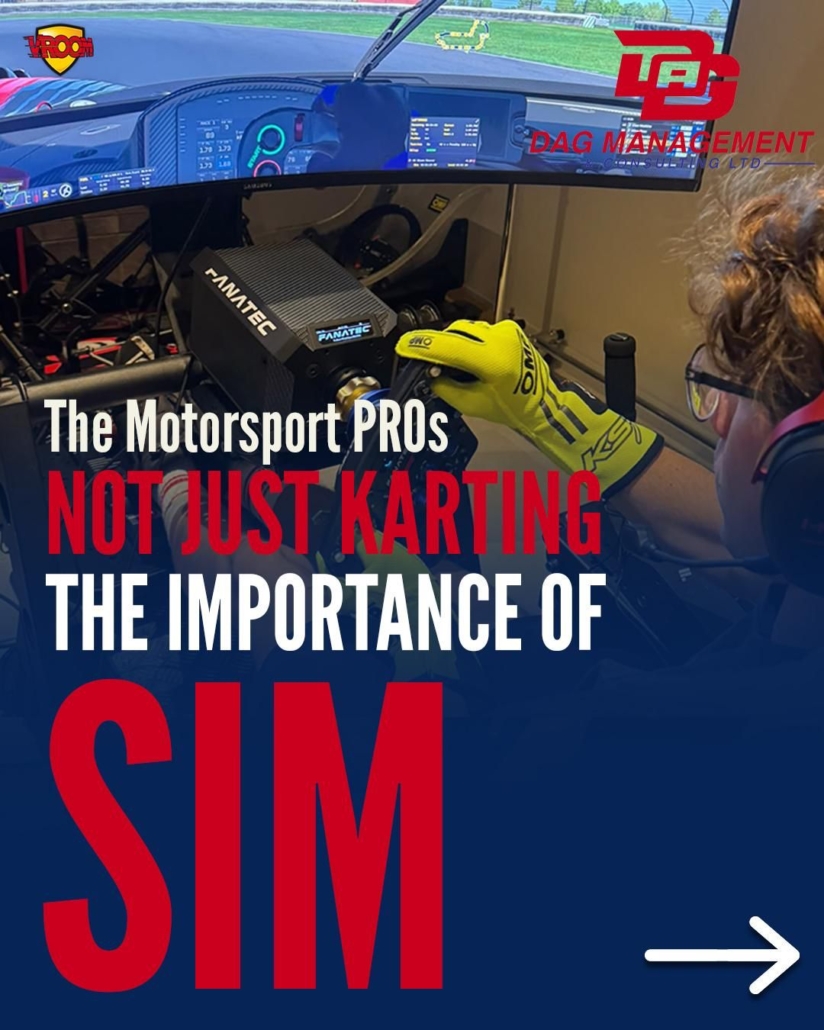
MORE THAN KARTING: THE FUNDAMENTAL IMPORTANCE OF THE SIM
For those aspiring to a professional career, simulator training is essential. While karting teaches the fundamentals of driving, on-track attack and defence, and sharpens reflexes, simulators provide the necessary additional training to master a modern racing car efficiently. Let’s explore why karting and SIM racing complement each other, and why, at a certain point, you simply cannot do without the SIM. (fm)
When Verstappen spoke about it in an interview, social media users were quick to take sides, as so often happens. Karting or Sim? Which is the road to F1? As those working in the industry know, this is a subject that does not lend itself to superficial analysis. And above all, some may be disappointed to learn that neither path takes precedence over the other. Quite apart from how professional drivers choose to spend their free time.
We discuss the subject with Francesco Svelto, an expert in simulator training and programme director at RFE Team. Over the years, he has followed the major technological advances in simulation and, together with coaches Mattia Nachira and Sergio Suardi, leads the simulator training programme developed through the collaboration between RFE Team and DAG Management for young drivers.
Let’s start with a basic distinction: where is the line between a “video game” and a professional racing simulator?
The distinction depends much less on the software than people might think, and much more on how it is used. The leading platforms, such as iRacing, which we use for all our work, feature laser-scanned circuits, tyre, suspension and aerodynamic physics models often developed using manufacturers’ data, and cars that actually compete in real-world championships, from Formula 4 to GT racing. A video game is designed to entertain and is forgiving of mistakes; a simulator reproduces the behaviour of a car even when it is difficult to drive. Then there is the hardware, which matters just as much as the software. The clearest example is the pedal set: a load-cell pedal measures the force the driver applies to the brake, just as in a real car, whereas a pedal set that measures only pedal travel trains a different movement. For a driver learning to modulate braking pressure, this is a fundamental difference, not a minor detail. The final distinction is methodology. The same software can be a game or a working tool: it becomes a professional simulator when every session has a specific objective, performance is measured through telemetry, and the results are compared with those of previous sessions.
So, what exactly do we mean by professional simulator training, or training designed in any case for drivers competing in professional championships?
We are talking about a programme that starts on the real track. Our approach begins with an analysis of the driver’s actual on-track data: telemetry, onboard footage, setup, race and test feedback, as well as the driver’s own impressions behind the wheel. This analysis provides the foundation for the simulator programme: which circuits to use, which technical aspects to focus on, and in what order. Only after an in-depth assessment do our engineers and coaches move on to the practical side, through dedicated simulator sessions.
The programme was developed through the collaboration between RFE Team and DAG Management, with the two organisations bringing complementary expertise to the table. DAG Management oversees every aspect of its drivers’ professional and sporting careers, identifying the strategies, tools and partnerships best suited to each stage of their development. When it considers the time right to introduce specific simulator training, it brings in specialised technical partners such as RFE Team. RFE Team provides simulation expertise, a structured organisation and a dedicated technical staff. The result is a programme in which what happens on track and what we do in the simulator are constantly connected, rather than treated as two separate activities. Two distinct specialists work within the programme: Mattia Nachira, driving coach and iRacing team manager at RFE Team, who focuses on driving technique, and Sergio Suardi, a former race engineer in real-world motorsport, who handles telemetry and setup. Each session is devoted entirely to one of these two areas: either the driver works on driving technique with Mattia or analyses the data with Sergio, never both at the same time, because the driver needs to know exactly what they are working on. Circuit selection is also deliberate. Monza, for example, allows us to isolate braking: heavy braking zones on the straights, without having to manage steering at the same time. Barcelona offers very different braking zones, while Misano has compact, repeatable braking points. We build direct before-and-after comparisons, and after every session the driver, family and management receive a written report.
The cycle then closes by returning to reality. We schedule sessions around races and tests, prepare the circuits the driver will be visiting in advance and, after every real-world test, use the new data and the driver’s feedback to adjust the simulator work. This is where a structured simulator programme makes a difference, particularly for younger drivers. A youngster moving up towards Formula 4 cannot test as often as they would like: days in a real car are limited, expensive and tied to the team’s schedule, with weeks often passing between sessions. In the simulator, that time can become productive training time, but only if there is a clear direction. Free practice laps alone risk reinforcing bad habits. With a programme built around real-world data and followed by a debrief after every test, the driver arrives at the next track day having already worked on the corners, braking points and conditions they will encounter. This allows them to devote their time on track, which is the most valuable of all, to what only real-world driving can teach.
In karting, progression through the categories is closely linked to a driver’s physical development, following a clear path from Mini to Junior, Senior and beyond. How does this progression work in sim racing? Many people start using simulators at a very young age, which perhaps brings us back to the recreational side of the discipline. When does sim racing become serious training?
In sim racing, there is no physical constraint dictating the categories as there is in karting, but progression certainly exists, and it is based on skills. First, drivers learn car control and consistency; then braking technique, which is the biggest step for those coming from karting; then data analysis and setup; and finally race management, traffic management and endurance racing with teammates. The platforms themselves have a licensing system that allows drivers to progress only if they drive cleanly, which already provides an initial filter.
Starting young is absolutely fine: a youngster who uses a simulator from an early age becomes familiar with circuits and the steering wheel. Sim racing becomes serious when time spent in the simulator stops being a succession of laps and becomes goal-oriented training. For a kart driver, in our experience, the right time is when the move to single-seaters comes into view within the next one or two years. That is the time needed to develop solid braking technique before getting behind the wheel of a real Formula 4 car. There is also a very practical reason for younger drivers: the simulator is available all year round, whatever the weather and at any time, allowing them to practise regularly what they can only do a handful of times on track. That is precisely why structure matters. In our experience, one hour a week with a clearly defined objective is worth more than many hours of free practice.
Let’s look at the connection with karting: what are the benefits of combining kart races and training with simulator preparation? Are there any potential drawbacks? If so, what are they?
The two are complementary, and we see it every day. Karting provides things a simulator cannot: genuine wheel-to-wheel battles, reflexes, physical sensitivity to grip, fitness and the ability to manage fear. The simulator teaches what karting does not: braking with weight transfer and aerodynamic effects, trail braking — progressively releasing the brake while turning into a corner — gear shifting, telemetry analysis and communication with the engineer. It also allows drivers to learn a circuit by heart before arriving there in a real car, when every test lap comes at a significant cost. There is also a very tangible advantage: the simulator is available when the track is not. Between race weekends, a young driver has few opportunities to drive a real car. In the simulator, they can repeat the same braking manoeuvre or sector dozens of times under identical conditions, without wearing out equipment or taking risks. This is also why the collaboration between RFE Team and DAG Management integrates simulator work into the driver’s actual schedule rather than treating it as a separate activity.
There are potential drawbacks. Some karting habits need to be “unlearned” when moving into a car, starting with braking technique. Other habits can develop in the simulator itself, where mistakes cost nothing and there is no physical sensation of acceleration. This is why the simulator must always be calibrated against reality. Here is a practical example: after a real Formula 4 test, one of our drivers told us that, with a particular tyre compound, the rear of the car was much more nervous than they had expected based on the simulator. We adjusted our approach: a setup replicating the real car, a less stable variation to practise managing oversteer, more challenging track conditions and reference points taken from actual onboard footage. Finally, there is the question of time: simulator training must not take time away from karting or physical conditioning. That is why we schedule sessions with sufficient room before and after on-track commitments.
Let’s talk about costs. A common assumption is that, given the high cost of karting, investing exclusively in sim racing could be more advantageous, potentially offering a cheaper route into motorsport. First of all, what does professional simulator training cost to get started? And how does it differ from what drivers can do independently at home?
It is true that an hour in a simulator costs a fraction of an hour on track, but the idea that sim racing can replace karting as a cheaper route into motorsport is misleading: the simulator helps drivers prepare, but a racing career is still built on track. That said, the entry cost for equipment is reasonable. As a rough guide, based on current market prices:
- Entry-level setup (basic steering wheel and pedals, stand, suitable PC): approximately €1,500–€2,500;
- Serious setup for single-seater preparation (direct-drive wheelbase, load-cell pedals, rigid cockpit, three monitors or an ultrawide screen): approximately €3,500–€7,000, including the PC;
- High-end equipment, with professional-grade wheelbases and pedal sets, including motorised active braking systems: easily exceeding €10,000;
- Dynamic simulators used by racing teams (driver-in-the-loop systems) belong to a different category altogether, costing hundreds of thousands of euros or more.
On top of that, there are platform subscriptions and purchases of cars and circuits, ranging from a few dozen to several hundred euros a year, depending on the content. As for the difference between professional training and working independently, home equipment can now be entirely adequate. What makes the difference is the method: clear objectives, data analysis, a coach who tells you what you are doing wrong and why, and a progression built around your calendar. The first investment we always recommend is a load-cell pedal set, even before upgrading the wheelbase or monitors. This is where the transfer of braking technique from the virtual car to the real one really begins.
Ultimately, the added value lies not in the rig itself, but in the programme. This is what DAG Management and RFE Team have chosen to offer their drivers: not just a tool, but a method, a team of specialists and continuity in their training.
As far as professional simulators are concerned, how much has the technology advanced over the past three years, and what role could AI play in this evolution?
Over the past three years, the most significant advances have been in hardware. Direct-drive wheelbases, which deliver force feedback without gears or belts, have become standard even at accessible price points. Load-cell pedal sets are now widespread, and motorised active pedals have arrived, capable of reproducing the braking response of a specific car, including ABS intervention. Software has also improved, with better tyre models, track evolution based on temperature and rubber laid down on the racing line, and more realistic rain simulation. The result is that drivers can now train at home using equipment that, only a few years ago, was reserved for professionals.
AI will play an important role, particularly in three areas: automated telemetry analysis, identifying in seconds where and why time is being lost by comparing thousands of laps; more realistic virtual opponents, allowing drivers to practise racecraft even when training alone; and setup assistance, helping them reach a coherent configuration more quickly. We already use AI in the organisational side of our programme. However, it will not replace the coach. A machine can tell you where you are losing time, but you need a person to understand why, turn that information into an exercise, and know when a driver needs to be pushed and when they need reassurance.
One final question for anyone interested in exploring the world of sim racing in greater depth: how are a driver’s simulator training sessions structured, and when should kart drivers who have no professional simulator experience make the transition from “gaming” to proper training? In these cases, do you recommend setting up a simulator at home or going to specialised centres with top-level equipment? Every session is based on the preliminary analysis of the driver’s real-world data, so it always has a specific focus. Our sessions last two hours and are conducted remotely: the driver uses their own rig, while the coach connects via voice and video and monitors laps and data in real time. Before driving, we check the setup — pedal calibration, force feedback and settings — then begin with a series of reference laps. We work on one aspect at a time, whether it is a braking zone, a particular type of corner or pace consistency, and finish by comparing the data with the starting point. At the end of the session, the coach prepares a written report outlining the findings and the areas to work on next time.
For a kart driver who has never undertaken structured simulator training, the first step is a shorter trial session, which we see as a mutual assessment. We check the equipment, observe the driver’s technique and determine whether and how to build a programme. As I mentioned earlier, the right time is when the move to cars starts to get closer. As for equipment, our recommendation is to have a simulator at home. Training relies on frequency and repeatability: using the same seating position, pedals and settings every time is what makes it possible to compare one session with another. Specialist centres with high-end dynamic simulators offer a valuable experience, particularly ahead of a test or when working with a team, but they cannot replace consistent training. Nor is it necessary to start with top-of-the-range equipment. When a driver joins the programme, we assess their existing setup and recommend only the upgrades that are genuinely needed, starting with the pedals.
Finally, the drivers we support in collaboration with DAG Management benefit from an additional level of continuity: the written reports produced after every session are shared with the driver, their family and management. This allows everyone involved in the youngster’s development to see what has been covered, what has improved and what the next objectives are. It is a way of working as a team even from a distance: driver, family, management, coaches and engineers all work towards the same goals using the same data. That is the essence of the collaboration between DAG Management and RFE Team: giving young drivers the opportunity to keep developing, even when they cannot be on track.