
FORMULA 1 | MEXICO CITY GRAND PRIX 2026
DAG MANAGEMENT EDITORIAL
Mexico City delivered a weekend that will be remembered for two stories that belong together: Max Verstappen’s extraordinary victory and Kimi Antonelli’s historic World Championship. For DAG Management, the most powerful lesson is that winning a race and winning a title demand overlapping but distinct qualities. One rewards execution at the highest intensity on a particular Sunday; the other rewards consistency, maturity and strategic intelligence across an entire season.
At just 20 years old, Antonelli became the youngest Formula 1 World Champion. He did not need to win in Mexico. He needed to understand the points situation, remain composed through a red flag and a late Safety Car, and bring home a meaningful result. Third place was enough. The achievement is particularly instructive for every young driver: long-term success is rarely a straight line of victories; it is the ability to turn different weekends into the right result.
Verstappen, by contrast, demonstrated the value of decisive racecraft. From fourth in qualifying, he gained ground at the start, benefited from the shifting race order and then defended against an exceptionally fast Lewis Hamilton. His winning margin of 0.799 seconds says everything about the intensity of the final laps. Ferrari can take genuine encouragement from Hamilton’s pole and second place, together with Leclerc’s fourth. Alpine also deserves recognition for a double points finish, led by Franco Colapinto.
Our editorial position remains positive but rigorous: every driver deserves to be assessed against the technical reality, the opportunities available and the decisions made under pressure. Mexico reminded us that resilience is not merely recovering after an error; it is also remaining calm when history is within reach.
FRIDAY – PREPARATION AT ALTITUDE
The Autódromo Hermanos Rodríguez is a highly specific engineering challenge. Its altitude reduces air density, complicating cooling and downforce generation, while the long run to Turn 1 makes starting position and slipstream especially influential. Teams must balance straight-line efficiency, braking stability and tyre temperatures without relying on a conventional low-altitude setup.
The analytical value of Friday is therefore not a single headline time. The crucial questions are how quickly drivers build confidence under braking, how clearly they describe rear-tyre behaviour and whether the car remains stable across different fuel loads. In a season approaching its decisive phase, every preparation run must serve a purpose.
SATURDAY – HAMILTON’S POLE AND AN EXTREMELY TIGHT FRONT GROUP
Hamilton secured pole in 1:16.514, just 0.009 seconds ahead of George Russell. Leclerc qualified third in 1:16.633, Verstappen fourth in 1:16.692 and Antonelli fifth in 1:16.707. Five drivers from four different cars were separated by less than two tenths: a remarkable measure of the competitive intensity.
Norris qualified sixth, Hadjar seventh and Lindblad eighth, confirming encouraging pace from both Red Bull organisations. Gasly reached ninth and Hülkenberg tenth. Colapinto was 11th and Piastri suffered a surprise Q2 elimination in 12th, creating two very different recovery opportunities on Sunday.
For DAG Management, Hamilton’s nine-thousandths margin is a reminder that qualifying excellence is built from hundreds of precise actions: braking release, rotation, throttle pickup and respect for the track limits. Antonelli’s fifth place did not compromise his title objective; it required a different strategic approach.
SUNDAY – A RACE OF RESTARTS, PENALTIES AND COMPOSURE
The 71-lap Grand Prix was shaped by an opening-lap battle, a major mid-race red flag and a late Safety Car. Verstappen surged forward from fourth, while the Ferraris became central to the early fight. Leclerc received a time penalty for leaving the track and gaining an advantage in the opening-lap exchanges, changing the strategic picture at the front.
A heavy accident for Bottas led to the red flag. The standing restart brought the front runners back into direct combat: Hamilton attacked Verstappen into Turn 1, the two made slight contact, and the Red Bull driver retained the advantage. Antonelli then moved past Leclerc to establish himself in podium position.
Behind them, Piastri recovered from 12th in qualifying, but his late attempt to overtake Lindblad ended in contact. Lindblad retired, and the stewards imposed a post-race ten-second penalty on Piastri. The incident is a useful lesson in judgement: a promising recovery can be undone by one overtaking decision.
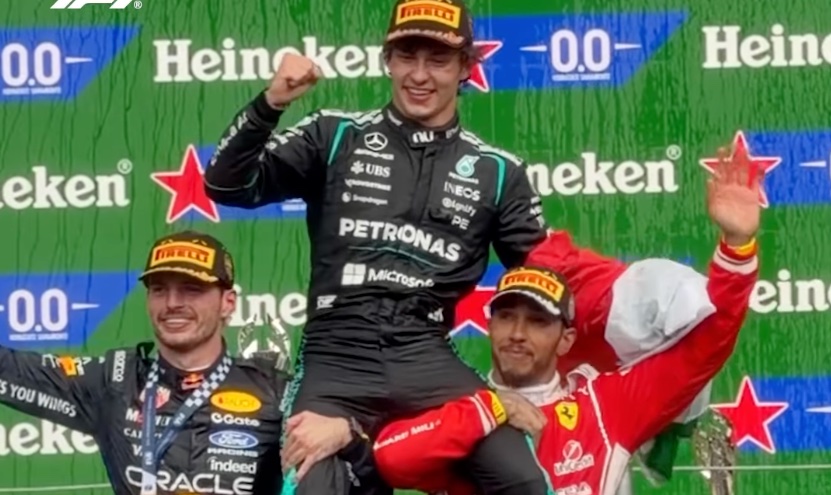
The late Safety Car compressed the field again. Verstappen executed the restart with precision and resisted Hamilton to win by just 0.799 seconds. Antonelli finished third, 4.006 seconds behind the winner, and secured the World Championship. Leclerc finished fourth, followed by Norris and Russell.
The midfield also deserves attention. Colapinto brought Alpine home eighth, Lawson ninth and Gasly tenth in the initial race order, giving Alpine two points-scoring drivers. However, the published race-result table was marked provisional, and Piastri’s post-race penalty subsequently changed the classification. This report flags that stewarding development rather than presenting the first published table as final.
CHAMPIONSHIP PERSPECTIVE – A HISTORIC TITLE
Antonelli arrived in Mexico needing only ninth place to secure the championship regardless of the results of his rivals. He finished third. At 20, he became the youngest World Champion in Formula 1 history, a milestone that should be understood as the culmination of a season rather than a single afternoon.
The result also gives the final races a different competitive meaning. Antonelli can now race as champion, while Ferrari, Red Bull and McLaren continue to measure technical progress and future direction. Verstappen’s third victory of the year shows that momentum can change even after a difficult opening phase of a season.
DAG MANAGEMENT REPORT CARDS
DAG editorial ratings out of 10, assessing pace, execution, strategy, discipline and technical context.
RED BULL — RATING: 9.5
MAX VERSTAPPEN — RATING: 10 | P1
Victory from fourth in qualifying, decisive racecraft through the red flag and Safety Car restarts, and calm defence against Hamilton to win by 0.799s.
ISACK HADJAR — RATING: 7 | P12
Seventh in qualifying but outside the points after a turbulent race. His qualifying pace remains a positive indicator.
FERRARI — RATING: 9.5
LEWIS HAMILTON — RATING: 9.5 | P2
Pole by just 0.009s over Russell and a forceful race, including an attack for the win at the final restart.
CHARLES LECLERC — RATING: 8.5 | P4
Third in qualifying, then a difficult race featuring a first-lap track-cutting penalty and fierce Ferrari battles. He recovered to fourth.
MERCEDES — RATING: 9.5
KIMI ANTONELLI — RATING: 10 | P3
Fifth in qualifying, podium in the race and the 2026 World Championship at age 20. He achieved the title through season-long consistency rather than unnecessary risk.
GEORGE RUSSELL — RATING: 8 | P6
Second on the grid, sixth at the flag. The result is below qualifying potential but his season-long contribution remains substantial.
MCLAREN — RATING: 6.5
LANDO NORRIS — RATING: 8 | P5
Sixth in qualifying and fifth at the finish, with disciplined execution amid repeated race interruptions.
OSCAR PIASTRI — RATING: 5.5 | P15*
Recovered from a Q2 exit but received a post-race 10-second penalty for causing the collision that retired Lindblad; classified P15, no points.
ALPINE — RATING: 8.5
FRANCO COLAPINTO — RATING: 9 | P8
From 11th in qualifying to eighth: four points and an encouraging performance under pressure.
PIERRE GASLY — RATING: 8 | P10
Ninth in qualifying and tenth in the race: a valuable point and a double-points result for Alpine.
RACING BULLS — RATING: 7
LIAM LAWSON — RATING: 8 | P9
Ninth at the finish, securing two points through disciplined race management.
ARVID LINDBLAD — RATING: 7 | DNF
Eighth in qualifying, competitive in the race until contact with Piastri forced retirement; the incident was judged not to be his fault.
AUDI — RATING: 6.5
GABRIEL BORTOLETO — RATING: 7.5 | P11†
Strong recovery and narrowly outside the top ten on the initially published classification; later stewarding altered the points positions.
NICO HÜLKENBERG — RATING: 5.5 | P16
Qualified tenth, but a Turn 4 collision with Bearman brought a ten-second penalty and compromised the race.
HAAS — RATING: 6
RYO HIRAKAWA — RATING: 7 | P13
Completed the distance in 13th in a demanding weekend, gaining valuable racing mileage.
OLIVER BEARMAN — RATING: 6 | DNF
Retired after contact with Hülkenberg, an incident for which the Audi driver received a penalty.
WILLIAMS — RATING: 6
ALEXANDER ALBON — RATING: 6.5 | P14
Completed the race in 14th; a clean finish in a difficult competitive window.
CARLOS SAINZ — RATING: 6 | P15‡
Finished behind Albon on the original result sheet; no points, but a full race of operational learning.
ASTON MARTIN — RATING: 5
FERNANDO ALONSO — RATING: 5.5 | DNF
Early retirement on Lap 5 prevents a meaningful assessment of race pace.
LANCE STROLL — RATING: 5.5 | DNF
Also retired after five laps; reliability and race survival dominated the assessment.
CADILLAC — RATING: 5.5
SERGIO PÉREZ — RATING: 6.5 | P17
Completed his home Grand Prix, a significant moment for the Mexican driver and a valuable full-distance result for the new team.
VALTTERI BOTTAS — RATING: 5.5 | DNF
Retired after 42 laps following a heavy accident that triggered a red flag; the technical and safety response becomes the priority.
WEEKEND HIGHLIGHTS
DRIVER OF THE WEEKEND — MAX VERSTAPPEN. Victory from fourth and outstanding control through two major restarts.
HISTORIC PERFORMANCE — KIMI ANTONELLI. Third place and the youngest-ever F1 World Championship.
QUALIFYING PERFORMANCE — LEWIS HAMILTON. Pole by nine thousandths and second place after a relentless fight for victory.
MIDFIELD RESPONSE — FRANCO COLAPINTO. Eighth place and valuable points for Alpine.
RACECRAFT LESSON — OSCAR PIASTRI / ARVID LINDBLAD. A post-race penalty illustrates the cost of an avoidable late-race collision.
DAG MANAGEMENT CONCLUSIONS
Mexico City was a weekend that rewarded both immediate excellence and long-term discipline. Verstappen’s victory was built on decisive execution in a race where circumstances changed repeatedly. Hamilton’s pole and relentless pursuit showed Ferrari’s competitiveness. Leclerc’s fourth place, despite a penalty, demonstrated the importance of continuing to maximise a difficult Sunday.
Above all, Antonelli’s championship offers a powerful message to young drivers and families. A career is not built only by finding the maximum speed. It is built through the relationship between driver, engineers, team and the people who guide the project; through careful decisions; and through the maturity to recognise when a podium is worth more than a risky attempt at victory.
For DAG Management, the defining principle is simple: performance must be evaluated in context, and ambition must be supported by judgement. Mexico gave us a race winner, a new World Champion and a series of lessons that will remain relevant far beyond this season.